
Speak Like a Pro: Decoding "Boat Mechanic" at Buck’s Island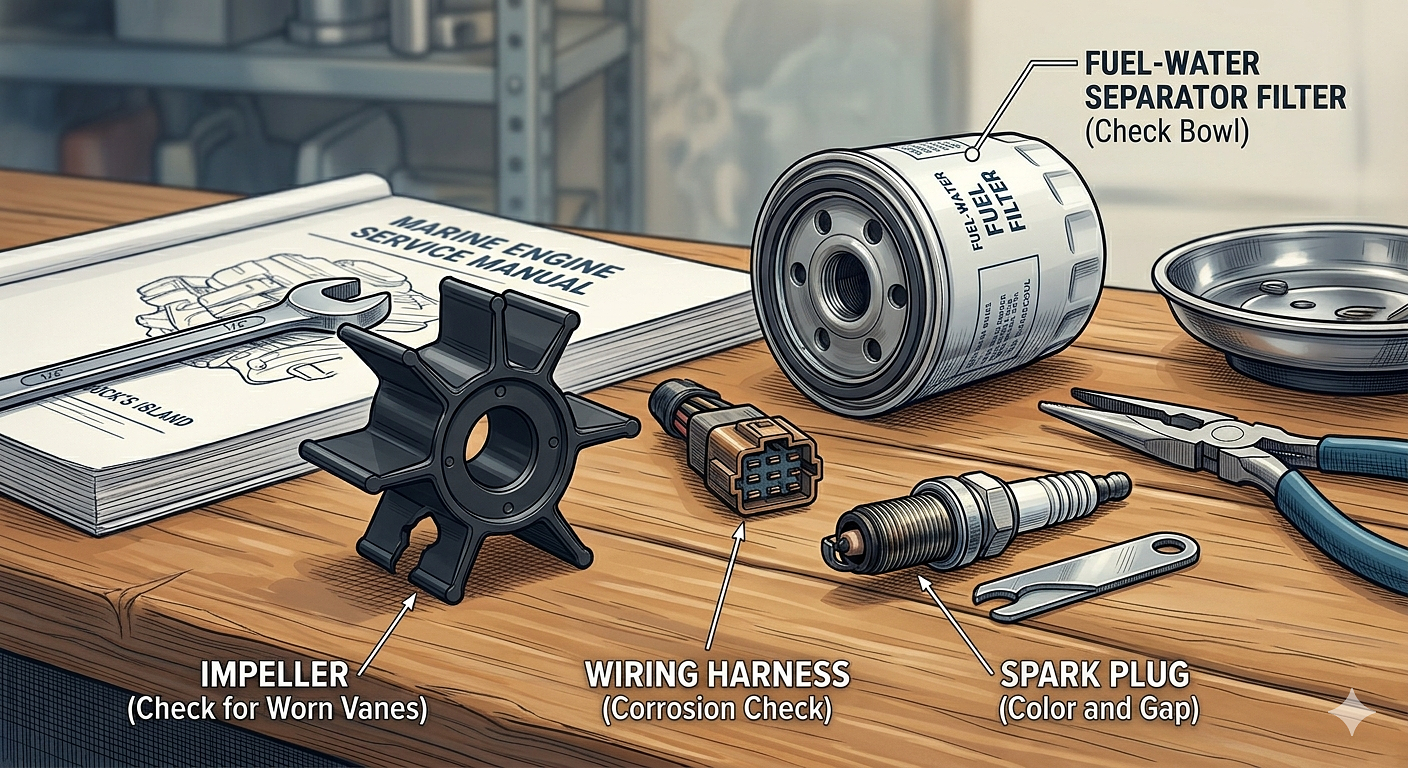
Walking into a service department can sometimes feel like you’ve accidentally wandered into a foreign film without subtitles. When your boat is acting up, the last thing you want is a communication breakdown between you and the person holding the wrench.
At Buck’s Island, we want to get you back on the water as fast as possible. The secret to a speedy repair? Speaking the same language. Here is your "cheat sheet" for boat mechanic terminology and tips on how to describe your issues like a seasoned captain.
1. Boat Mechanic Vocabulary Before you call, make sure we’re talking about the same "thingy."
- "Lower Unit": The bottom part of your outboard (the "foot"). Holds the gears and the prop.
- "Skeg": The metal upside-down 'shark' fin at the bottom of the foot. Protects the prop from impacts, provides directional stability, and acts as a rudder for steering (especially at high speeds).
- "Cavitation Plate": the flat horizontal wing above the prop. Designed to keep air from reaching the prop.
- "The Impeller": A small rubber star-shaped fan inside the pump. It moves water to cool the engine. If it fails, you overheat.
- "Tell-Tale" (or Pilot Hole): The little stream of water shooting out the back of your outboard. Boaters look this up to see if it’s normal for the stream to be weak (Hint: it’s not—if it’s weak, your impeller is likely failing).
- "Thermostat": Just like in a car, this regulates engine temperature. In saltwater or sandy water, these can stick open or closed.
- "Propeller Pitch": This is essentially "gearing" for your boat. People look this up when their boat feels sluggish or won't get on "plane" (level out on the water).
- "Hub Kit / Spun Hub": Inside your prop is a rubber sleeve. If you hit a stump, it’s designed to "spin" or break to save your engine from damage. If your engine revs high but you aren't moving, you likely have a "spun hub."
- "EFI / DFI": Electronic Fuel Injection or Direct Fuel Injection. If you have these, you don’t have a carburetor.
- "VST" (Vapor Separator Tank): It’s a small tank inside the engine that filters fuel and removes air bubbles. If your boat bogs down at high speeds, this is often the culprit.
- "Primer Bulb": The rubber "squeeze ball" on your fuel line.
- "Cranking vs. Deep Cycle": Boaters often look up the difference. Cranking batteries give a big burst of power to start the engine; Deep Cycle batteries provide steady power for your trolling motor and electronics.
2. Translating "The Noise"
Mechanics are like doctors—they need to know the symptoms to find the cure. Instead of saying "It sounds weird," try using these descriptors:
- "Surging": The RPMs go up and down on their own while you're holding the throttle steady. (Usually a fuel or air issue).
- "Bogging": You give it gas, but the engine feels heavy and sluggish, like it’s trying to run through mud. (Often fuel or spark plug related).
- "Chirp" or "Squeal": Usually points to a belt or a bearing.
- "Knocking": A heavy, rhythmic metal sound. (This is the one that tells you to turn the engine off immediately.)
3. Help Us Help You: The Service "Must-Haves"
When you call the Buck’s Island service team, having these three things ready will save you (and us) a massive amount of time:
- The Serial Number: Every engine is a little different. Your serial number is the DNA of your motor.
- The "When": Does it happen only when the engine is cold? Only at full throttle? Only after it’s been sitting for three weeks?
- Recent History: "I just hit a stump," or "I just filled up at a new gas station" are the most helpful things you can tell a mechanic. Don't be shy—we've heard it all!
4. Common Phrases You’ll Hear From Us
- "Checking the lower unit lube": We’re looking for "milky" oil, which means water is leaking in.
- "Scanning or checking for codes": Just like a car, modern outboards have a brain (ECU) that help tell what went wrong.
- "Winterization": Preparing your boat for the off-season so the block doesn't crack and the fuel doesn't go bad.
The Bottom Line
You don't need a degree in marine engineering to get great service at Buck’s Island. You just need to be observant. The more "clues" you provide, the faster our techs can solve the mystery and get you back to chasing bass or pulling tubes.
Is your boat acting up? Give our service department a call or swing by the shop. Let’s get it sorted!